
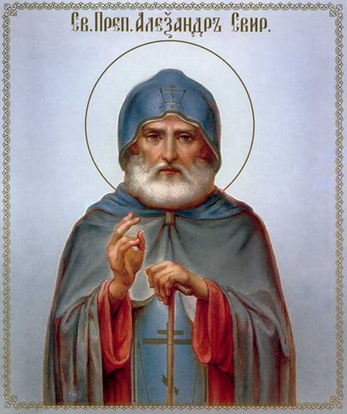
The Monk Alexander of Svirsky was born on June 15, 1448, on the day of remembrance of the Prophet Amos, and at Baptism he was named after him. All his life, staying away from historical events, the Monk Alexander, the luminary of monasticism, in the depths of the forests of the Russian North, experienced a different, spiritual history, having been rewarded with the extraordinary gifts of the Holy Spirit.
His parents, Stefan and Vassa (Vasilisa), were peasants in the Ladoga village of Mandera, on the banks of the Oyat River, a tributary of the Svir River. They had two children who were already grown up and living separately from their parents. But Stefan and Vassa wanted to have another son. They prayed earnestly and heard a voice from above: “Rejoice, good marriage, you will give birth to a son, in whose birth God will give consolation to His Churches.”
Amos grew up to be a special youth. He was always obedient and meek, avoided games, laughter and foul language, wore scanty clothes and exhausted himself with fasting so much that he worried his mother. Upon reaching adulthood, he once met with Valaam monks who came to Oyat to buy things necessary for the monastery and for other economic needs.
By this time, Valaam was already known as a monastery of high piety and strictly ascetic life. After talking with them, the young man became interested in their story about the hermitage (two or three together) and hermit life of the monks. Knowing that his parents wanted to marry him, the young man at the age of 19 secretly went to Valaam. Under the guise of a companion, an Angel of God appeared to him and showed him the way to the island.
Amos lived in the monastery for seven years as a novice, leading a harsh life. He spent his days in labor, his nights in vigil and prayer. Sometimes naked to the waist, covered with mosquitoes and midges, he prayed in the forest until the morning birdsong.
In 1474 Amos took monastic vows with the name Alexander. A few years later, the parents accidentally learned from Karelians who came to Mandera where their son had disappeared. Following the example of their son, the parents soon also went to the monastery and took monastic vows with the names Sergius and Varvara. After their death, the Monk Alexander, with the blessing of the abbot of the monastery, settled on a secluded monastic island, where he built a cell in a cleft in the rock and continued his spiritual exploits.
The glory of his exploits spread far. Then the monk in 1485 left Valaam and, according to instructions from above, chose a place in the forest on the shore of a beautiful lake, which later became known as the Holy Lake. Here the monk built himself a hut (Subsequently, on this place, near the Holy Lake, 36 versts from the future city of Olonets and 6 versts from the Svir River, the venerable Alexander founded the monastery of the Life-Giving Trinity, and 130 fathoms from it, near Lake Roshchinsky, he built himself "waste desert", on the site of which the Alexander-Svirsky monastery later arose.) and lived alone for seven years, eating only what he collected in the forest. At this time, the saint experienced severe suffering from hunger, cold, illness and devilish temptations. But the Lord constantly supported the spiritual and physical strength of the righteous man. One day, when, suffering from painful illnesses, The monk not only could not get up from the ground, but also raise his head; he lay and sang psalms. And then a glorious husband appeared to him. Placing his hand on the sore spot, he marked the saint with the sign of the cross and healed him.
In 1493, the neighboring owner Andrei Zavalishin accidentally came across the saint’s home while hunting for a deer. Struck by the appearance of the righteous man, Andrei told him about the light he had seen earlier over this place, and begged the monk to tell him about his life. From then on, Andrei began to often visit the Monk Alexander and, finally, according to his instructions, he himself retired to Valaam, where he took monastic vows with the name Adrian. Subsequently, he founded the Ondrusovo monastery and became famous for his holy life (comm. August 26 and May 17; † 1549).
Andrei Zavalishin could not keep silent about the ascetic, despite the promise given to him. The glory of the righteous man spread widely, and monks began to gather to him. Then the monk secluded himself from all the brethren and built himself a retreat hermitage 130 fathoms from the common dwelling. There he encountered many temptations. The demons took on an animal form and whistled like a snake, forcing the saint to flee. But the saint’s prayer, like a fiery flame, scorched and scattered the demons.
In 1508, in the 23rd year of the saint’s stay in the reserved place, the Life-Giving Trinity appeared to him. The monk prayed at night in the waste hermitage. Suddenly a strong light shone, and the monk saw Three Men entering him, dressed in light, white clothes. Sanctified by Heavenly glory, They shone with purity, brighter than the sun. Each of them held a rod in His hand. The monk fell in fear, and, having come to his senses, bowed to the ground. Lifting him by the hand, the men said: “Trust, O blessed one, and do not be afraid.” The monk received orders to build a church and establish a monastery. He fell to his knees again, crying out about his unworthiness, but the Lord raised him up and commanded him to do what was specified. The monk asked in whose name the church should be. The Lord said: “Beloved, as you see Him speaking to you in Three Persons, so build a church in the Name of the Father and the Son and the Holy Spirit, the Consubstantial Trinity. I leave you peace and I will give you My peace." And immediately the Monk Alexander saw the Lord with outstretched wings, as if walking on the earth, and He became invisible.
In the history of the Russian Orthodox Church, this Divine descent is known as the only one. After this phenomenon, the monk began to think about where to build a church. One day, while praying to God, he heard a voice from above. Looking up into the heights, the monk saw an Angel of God in a mantle and a doll, just as St. Pachomius the Great saw. The angel, standing in the air with outstretched wings and raised hands, said: “One is Holy, One is Lord Jesus Christ, to the glory of God the Father, amen.” And then he turned to the monk: “Alexander, on this place may a church be built in the Name of the Lord who appeared to you in Three Persons, the Father and the Son and the Holy Spirit, the Indivisible Trinity.” And, having crossed the place three times, the Angel became invisible.

In the same year, the wooden Church of the Life-Giving Trinity was built (in 1526 a stone one was erected in its place). Immediately after the church was built, the brethren began to beg the monk to accept the priesthood. He refused for a long time, considering himself unworthy. Then the brethren began to pray to Saint Serapion, Archbishop of Novgorod († 1516; Comm. March 16), so that he would convince the monk to accept the rank. That same year the monk traveled to Novgorod and received dedication from the saint. Soon after, the brethren begged the monk to accept the abbess.
Having become abbot, the monk became even more humble than before. His clothes were all in patches, he slept on the bare floor. He prepared food himself, kneaded dough, baked bread. One day there was not enough firewood and the steward asked the abbot to send those of the monks who were idle to fetch firewood. “I am idle,” said the monk and began to chop wood. Another time he started carrying water the same way. And at night, when everyone was asleep, the monk often ground bread for others with hand millstones. At night, the monk walked around the cells and, if he heard vain conversations somewhere, knocked lightly on the door and left, and in the morning he instructed the brethren, imposing penance on the guilty.
Towards the end of his life, the Monk Alexander decided to build a stone church of the Intercession of the Most Holy Theotokos. The foundation of the temple was laid. One evening, after performing an akathist to the Most Holy Theotokos, the monk sat down to rest in his cell and suddenly said to his cell attendant Athanasius: “Child, be sober and watchful, because at this hour there will be a wonderful and terrible visitation.” A voice like thunder was heard: “Behold, the Lord comes and she who gave birth to Him.” The monk hurried to the entrance of the cell, and a great light shone around him, spreading over the entire monastery brighter than the rays of the sun. Having looked, the monk saw above the foundation of the Church of the Intercession, sitting on the altar, like a queen on a throne, the Most Pure Mother of God. She held the Child Christ in Her arms, and many angelic ranks, shining with indescribable lightness, stood before Her. The monk fell unable to bear the great light.
The Mother of God said: “Arise, chosen one of My Son and God! For now I have come to visit you, My beloved, and to see the foundation of My church. And because I prayed for the disciples and your monastery, from now on it will abound for everyone; and not only with "Your life, but even after your departure I will constantly remain from your monastery, generously giving everything you need. Look and observe carefully how many monks have gathered into your flock, who must be guided by you on the path of salvation in the Name of the Holy Trinity." The monk stood up and saw many monks. The Mother of God again said: "My beloved, if anyone brings one brick to the building of My church, in the Name of Jesus Christ, My Son and God, he shall not lose his reward." And She became invisible.
Before his death, the monk showed amazing humility. He called the brethren and commanded them: “Tie my sinful body at the feet with a rope and drag it into the swampy wilds and, burying it in the moss, trample it with your feet.” The brethren answered: “No, father, we cannot do this.” Then the monk indicated not to bury his body in the monastery, but in the waste hermitage, near the Church of the Transfiguration of the Lord. Having lived 85 years, the saint departed to the Lord on August 30, 1533.
The Monk Alexander of Svirsky became famous for his wondrous miracles during his life and after his death. In 1545, the disciple and successor of the monk, Abbot Herodion, compiled his life. In 1547, local celebrations of the saint's memory began and a service to him was compiled. In 1641, on April 17, during the reconstruction of the Church of the Transfiguration, the incorrupt relics of St. Alexander of Svirsky were found and a church-wide celebration was established for him on two dates: the day of repose - August 30 and the day of glorification (discovery of the relics) - April 17. (About the Venerable Alexander Svirsky: Archbishop Pitirim. The Church as the implementation of the Trinitarian Economy - "Journal of the Moscow Patriarchate", 1975, N 1, p. 59. Volgin A. The Venerable Alexander Svirsky. - "Journal of the Moscow Patriarchate", 1978, N 8, p. 73-76).
A whole host of students was instructed and educated by the Monk Alexander of Svirsky, as the Mother of God bequeathed to him. These are the venerables: Ignatius Ostrovsky (XVI), Leonid Ostrovsky (XVI), Cornelius Ostrovsky (XVI), Dionysius Ostrovsky (XVI), Afanasy Ostrovsky (XVI), Theodore Ostrovsky (XVI), Ferapont Ostrovsky (XVI). In addition to these saints, the disciples and interlocutors of St. Alexander of Svirsky are known, having separate days of remembrance: St. Athanasius of Syandem (XVI, commemorated January 18), St. Gennady Vazheozersky († January 8, 1516, commemorated February 9), St. Macarius of Oredezh († 1532, commemorated August 9), Rev. Adrian Ondrusovsky († August 26, 1549, commemorated May 17), Rev. Nikifor of Vazheozersky († 1557, commemorated February 9), Rev. Gennady of Kostroma and Lyubimograd († 1565, commemorated January 23).
All these saints (except for St. Gennady of Kostroma) are depicted on the icon of the venerable fathers who shone in the land of Karelian (from the church of the Theological Seminary in the city of Kuopio, Finland). The celebration of the Synaxis of Saints who shone in the land of Karelian is celebrated by the Finnish Orthodox Church on Saturday between October 31 and November 6 (See about this: V. Rusak. Icon of the Reverend Fathers who shone in the land of Karelian. "Journal of the Moscow Patriarchate", 1974, No. 12 , pp. 16-21). "Journal of the Moscow Patriarchate", 1974, N 12, p. 16-21). "Journal of the Moscow Patriarchate", 1974, N 12, p. 16-21).
Take action! Resist the assault from the rainbow mafia: