
The little-known saint, whose feast day is May 14, is celebrating a comeback. To find out St. Corona's story, DW got in touch with the Aachen Cathedral, as it exhibits a reliquary said to contain her bones.
The coronavirus pandemic that has killed thousands of people worldwide is the reason that all of a sudden, people are aware of a Christian martyr believed to have been tortured to death by the Romans about 1,800 years ago. Her name: Corona — which means "crown" in Latin.
Aachen Cathedral, in western Germany, has just put on display in its treasure vault an elaborate reliquary believed to contain some of St. Corona's bones.
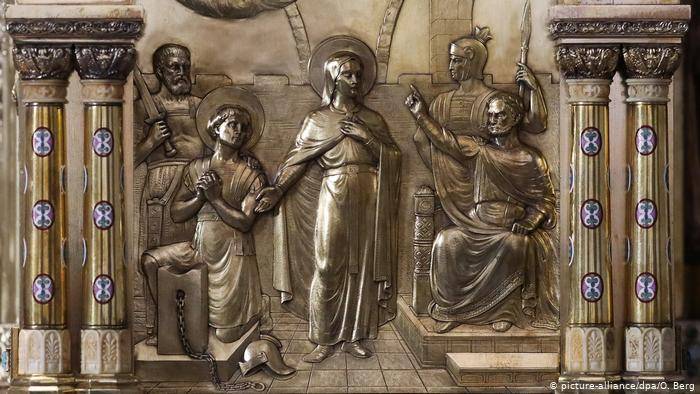
Long before the outbreak of the pandemic of the same name, the cathedral planned for an exhibition this summer displaying its precious gold craftmanship, and the freshly cleaned gold, bronze and ivory Corona shrine that was hidden from public view for 25 years was to be the highlight.
"We have brought the shrine out a bit earlier than planned," said Aachen Cathedral spokeswoman Daniela Lövenich.
Little-known patron saint
The mighty 9th-century cathedral is the burial place of Charlemagne, who died in 814 A.D.; it is also where many German kings and queens were crowned. It remains a prominent pilgrimage church to this day.

For hundreds of years, the Corona relics were stored underneath this massive marble slab
King Otto III brought Corona's relics to Aachen in 997. They were initially kept in a tomb underneath a slab on the cathedral floor for hundreds of years before they were moved to the shrine in the early 20th century.
Lövenich says that St. Corona is still revered today in parts of Bavaria and Austria.

A student painstakingly cleaned the precious reliquary for three months
Gamblers, treasure-hunters prayed to Corona
St. Corona is commonly thought to be the patron saint of butchers and treasure-hunters, prayed to in times of financial hardship. But some church representatives say she is also, at least locally, the patron saint for warding off infectious diseases.
People in the small Austrian town of St. Corona used to pray to the saint in difficult times, including to protect their livestock from contagious diseases, Lövenich says. But, she adds, that was very much a local phenomenon — one that has recently caught the attention of the media, as St. Corona, "patron saint of infectious diseases," is indeed a striking title for the times.