
Probably, we all often come across the opinion that dark forces act on a person in connection with damage or witchcraft. At the same time, few people pay attention to the real impact that a person is exposed to outside of any connection with magic. This means that it is important to have a correct understanding of the dark forces themselves and the ways they influence people.
Demons are personal, ethereal beings, endowed with reason, who have fallen away from God and formed a special world hostile to everything good. Having lost the spiritual Heaven, they are in the celestial or aerial sphere (see: Eph. 2:2) and they turn their evil attention to the world of people.
They have a certain power in this world, since the crown of creation — man — in the Fall, gave away his place as the king of the world to the evil deceiver. In this regard, it is clear that dark forces are capable of causing harm. So, in the Holy Scriptures, in the book of Tobit, it is said that the demon Asmodeus killed seven husbands in turn, for whom Sarah, the daughter of Raguel, had been married off (Tobit 3:8).
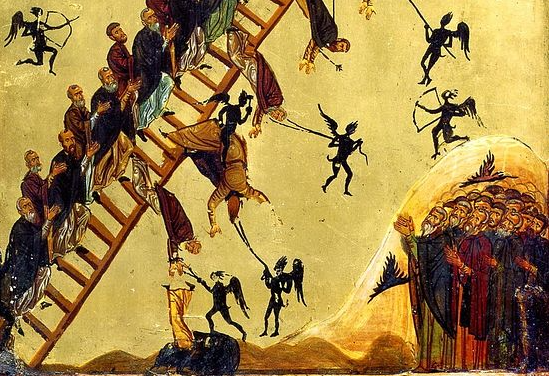
Demons tempt ascetics. Fragment of the Ladder icon. Sinai, XII century
The book of Job tells how fire, which seemed to come down from heaven, under the influence of the devil, burned the flocks of sheep that belonged to Job along with the shepherds (Job 1:16). Due to the obsession of dark forces, a powerful wind also appeared, destroying the house where Job’s children had gathered, so that they all died (Job 1:18–19). True, there is one peculiarity in this story. All the disasters that happened to Job and his family were allowed by God, who agreed to allow such demonic sabotage to test the righteous (Job 1:6–12).
This is what is important to focus on. Although the influence of demons on the world can be incredibly powerful in terms of destruction, they themselves are dependent on God and can act only when God allows. From the Gospel we know that even in order to enter the pigs, demons were forced to slavishly ask permission from the Savior (Matthew 8:31). Saint John Chrysostom explained this:
“Demons do not even dare to touch pigs without His permission... Everyone knows that demons hate us more than dumb animals. Consequently, if they did not spare the pigs, but in one instant cast them all into the abyss, then all the more would they have done this with the people possessed by them, whom they dragged through the deserts, if God’s Providence had not curbed and deterred their further aspirations.” [1]
This means that the true basis for our spiritual life should not be fear of fallen powers, but fear of God, fear of falling away from Him through our sins, through which we become more accessible to the direct influence of fallen angels.

Casting out demons from the Gadarene demoniacs. Fresco. Serbia. XIV century. Kosovo. Vysoki Decani
The world of fallen spirits is invisible to us, but is capable of manifesting its existence. Moreover, this manifestation often happens exactly where a person does not expect it, for example, in emerging thoughts, internal movements of the soul, and desires. The life of the holy martyr Juliana tells how one day during prayer the devil appeared to her in the form of a bright angel and urged her to make a sacrifice to demons. The Lord strengthened Saint Juliana, so that she remained above his temptations. The demon confessed to the holy saint:
“I am the one who once advised Eve in paradise to transgress the commandment of God to her destruction. I inspired Cain to kill his brother Abel. I taught Nebuchadnezzar to place a golden image in the field of Deira. I deceived the Jews to worship idols. I made the wise Solomon mad by arousing in him a passion for wives. I inspired Herod to kill infants, and Judas to betray the Teacher and hang himself. I inspired the Jews to stone Stephen, I inspired Nero to crucify Peter upside down and behead Paul with the sword. I have deceived many and subjected them to disasters.” [2]
Evil spirits are capable of putting thoughts into us that we perceive as our own. These are all those thoughts that lead to sin and prevent you from turning to God. Dark demons try to influence the will, arousing vicious desires in us, muffle the voice of conscience in us, calling us to enjoy all earthly blessings, and after reckless consumption, when the entire emptiness of a godless life is revealed, they bring despair to the soul.
It is naive to think that demons influence people necessarily in the form of creepy ghosts or in terrible forms of possession. Their influence on people can be very diverse and not always outwardly terrifying. For example, the truly terrible thing they do is that demons prevent a person from turning to God, to living according to the Commandments of the Gospel. “To everyone who hears the word about the Kingdom and does not understand, the evil one comes and snatches away what was sown in his heart” (Matthew 13:19), the Lord depicted in the parable the condition of those people who heard the gospel, but did not show zeal for it in time.
A person does not even suspect that the word of Truth once heard, which lay on his heart, but was not realized in life, was stolen by the evil one. Among the unbelievers, according to the words of the Apostle Paul, “the god of this age (that is, the devil) has blinded their minds, so that the light of the gospel would not shine on them” (2 Cor. 4:4). This is expressed in the inability to see and perceive the Truth of spiritual life, and preferring to it the dead treasures of the earthly world.
Demons, like competent psychologists, examine us, what we are most susceptible to, and with this they tempt us most of all. The Lord says: “Watch and pray, so that you do not fall into temptation” (Matthew 26:41). Without inner vigilance and constant turning to God, it is impossible to recognize the machinations of the evil one.
Demons, to put it in worldly terms, work individually with each person, according to his weaknesses and preferences. They seduce some with carnal pleasure, others with a thirst for honor and glory, and others with an opinion of themselves as a very virtuous person. According to Abba Evagrius,
“of the unclean demons, some tempt man as a human being, while others alarm man as a dumb animal. The first ones, having come, put into us thoughts of vanity, or pride, or envy, or condemnation, which do not concern any of the dumb; and the latter, approaching, arouse anger or lust not according to their nature, for these passions are common to us and the dumb and are hidden in us under the rational nature (that is, they stand below it or under it).” [3]
St. Anthony the Great taught that every Christian who succeeds in spiritual life is first tempted by demons through evil thoughts. If the ascetic turns out to be firm, then they attack him through dreamy ghosts. Then they take on the guise of soothsayers, so that the ascetic believes them as if they were predicting the truth.
“Therefore, when demons come to you at night, wanting to announce the future or to say: 'We are Angels,' do not listen to them; because they lie. If they praise your asceticism and please you, do not listen to them and do not get close to them in the least. It’s better to seal yourself and your house with a cross and pray.” [4]
If the fallen angels see that a person wants to achieve incredible self-development and perfection, then they are happy to help him discover all the “hidden possibilities” in himself, so that the greatness of the newly-minted psychic can surprise and captivate the hearts of many others. And if a person turns to an occultist in order to remove damage, they politely remove their own slander from him, as if showing that magic and extrasensory perception are truly good for people.
A striking example of such seduction is the famous Bulgarian fortuneteller Vanga (1911–1996). Like many other similar people, the emergence of Vanga’s special abilities was preceded by trauma: when twelve-year-old Vanga was returning to the village with her cousins, a terrible whirlwind lifted her into the air and carried her far into the field.
There she was covered with branches and sand; Vanga’s eyes hurt, and soon she went blind. After some time, she discovered “extraordinary” abilities. She could tell a person his past, reveal details that even loved ones did not know, determined people’s illnesses, and often predicted the future. She herself considered her abilities to be a gift from God.
Who exactly revealed to her these secrets hidden from mere mortals?
Vanga explained to her niece Krasimira Stoyanova that she saw higher powers as transparent figures, like human reflections in water, but more often heard their voice. Krasimira Stoyanova wrote several books about her aunt and in one of them she reports the following:
“I was 16 years old, when one day in our house in Petrich, Vanga spoke to me... only it was not her voice. There was an impression that it was not she, but some other person who was speaking through her lips. The words I heard had nothing to do with what we had talked about before. It was as if some unknown person had intervened in our conversation. I heard: “Here we see you”... - and then followed a full report of what I had done that day up to that moment.
After a short pause, Vanga sighed and said:
“Oh, my strength has left me”... - and again returned to our previous conversation. I asked her why she suddenly began to describe my day, but she replied that she did not describe anything, but repeated what she heard.
Then she sighed:
“Oh, these are forces, small forces that are always nearby. But there are also big ones who command them. When they decide to speak through my mouth, I feel bad, and after that I can’t come to my senses for the whole day.” [5]
The feeling of oppression that Vanga herself admits unmistakably indicates that dark spirits appeared to her, who are capable of telling people things that are inaccessible to ordinary knowledge. Krasimira Stoyanova provides various details about how Vanga communicated with the other world. In general, these are typical mediumistic experiences that have been known for many centuries:
“Only sometimes we could not understand why our aunt turns pale, why she suddenly feels bad and suddenly a voice comes from her lips, striking us with its strength, unusual timbre, words and expressions that are not in Vanga’s usual vocabulary.” [6]
“And suddenly she spoke to me in an unfamiliar voice, which sent shivers down my spine.” [7]
Of course, this type of seduction is exceptional. Usually people stumble over the smallest things: to better arrange earthly life, forgetting about their own immortal soul; elevate yourself and your successes to the first place, completely ignoring the sorrows and suffering of your neighbors. The goal of the devil is to sow anger, self-justification, and distrust of God in people. One of the enemy’s favorite suggestions is suspiciousness: a person invents whole stories for himself in connection with individual circumstances of his own life, and in illnesses and failures he sees not a manifestation of God’s Providence, but a magical obsession of an ill-wisher.
But there is one truth that is worth knowing. What harms the soul most is irreconcilable hostility towards other people, and it is this that most often makes one think about witchcraft on the part of one’s enemy. Usually a distant relative, neighbor, or co-worker is suspected of corruption or witchcraft. Thus, a fearful occult worldview is created in which personal troubles are combined with resentment against the supposed ill-wisher; as a result, Christianity is forced out of our everyday, everyday life by thoughts of conspiracies and the search for magical protection from them.
Elder Paisius the Holy Mountain has very useful reasoning in this regard:
“And what evil do mediums, psychics, 'clairvoyants' and the like do to people! Not only do they pump money out of people, they also destroy families. For example, a person goes to a 'clairvoyant' and tells him about his problems. 'Look,' the 'clairvoyant' answers him, 'one of your relatives, a little dark, slightly taller than average, has cast a spell on you.'
A person begins to look for which of his relatives has such characteristic features. It is impossible that none of his relatives were at least a little like the one the sorcerer described to him. “Ah,” says the man, having found the “culprit” of his suffering. “So that means she put a spell on me!” And he is overcome by hatred for this woman. And this poor thing herself does not know at all the reasons for his hatred.
It happens that she did him some favor, but he seethes with hatred towards her and does not even want to see her! Then he goes to the sorcerer again, and he says: “Well, now we need to remove this damage from you. To do this, you will have to pay me some money.” - “Well,” says the confused man, “since he I found whoever spoiled me, I must reward him!” And he forks out the money. Do you see what the devil is doing? He creates temptations.
Whereas a kind person — even if he actually knows for sure that someone did something bad to someone else — will never say this to the victim: “So-and-so did harm to you.” No, he will try to help the unfortunate person.” Listen,” he will tell him, “don’t accept different thoughts.” Go and confess and don’t be afraid of anything.” Thus he helps both one and the other. After all, the one who has harmed his neighbor, seeing how he behaves towards him with kindness, thinks — in the good sense of the word — and repents.” [8]
It turns out to be an amazing thing: the real attack of the enemy is not someone’s witchcraft or damage, but the opinion that the misfortune that happened was brought upon you by witchcraft. Regarding all the temptations of fallen angels in general, I would like to recall the words of Holy Scripture: “Be sober, be vigilant, because your adversary the devil walks around like a roaring lion, looking for someone to devour. Resist him with firm faith, knowing that the same sufferings happen to your brothers in the world. May the God of all grace, who has called us to His eternal glory in Christ Jesus, after you have suffered for a short time, perfect you, establish you, strengthen you, and make you steadfast. To him be glory and power forever and ever. Amen." (1 Peter 5:8-11)
+ + +
1. John Chrysostom, saint. Interpretation of St. Matthew the Evangelist // St. John Chrysostom. Complete collection of creations. T. 7. Book. 1. M., 1993. P. 318.
2. Lives of the saints as presented by St. Demetrius of Rostov. T. 12. December. Minsk, 2004. P. 1023.
3. Evagrius, Abba. Instructions on asceticism // Philokalia. T. 1. Publication of the Holy Trinity Sergius Lavra, 1993. pp. 630–631.
4. Athanasius the Great, Saint. Life of our Venerable Father Anthony // Athanasius the Great, Saint. Creations: In 4 volumes. T. 3. M., 1994. P. 207.
5. Stoyanova Krasimir. Vanga is clairvoyant and healing. M., 1998. pp. 11–12.
6. Ibid. P. 11.
7. Ibid. P. 131.
8. Paisiy Svyatogorets. Words. T. 3. Spiritual warfare. M., 2003. pp. 204–205.
Take action! Resist the assault from the rainbow mafia: